
Design · Assemble · Control
About GHFRC
From a drawing to a moving chassis, we connect mechanical design, hands-on assembly, and foundational programming through real engineering practice.
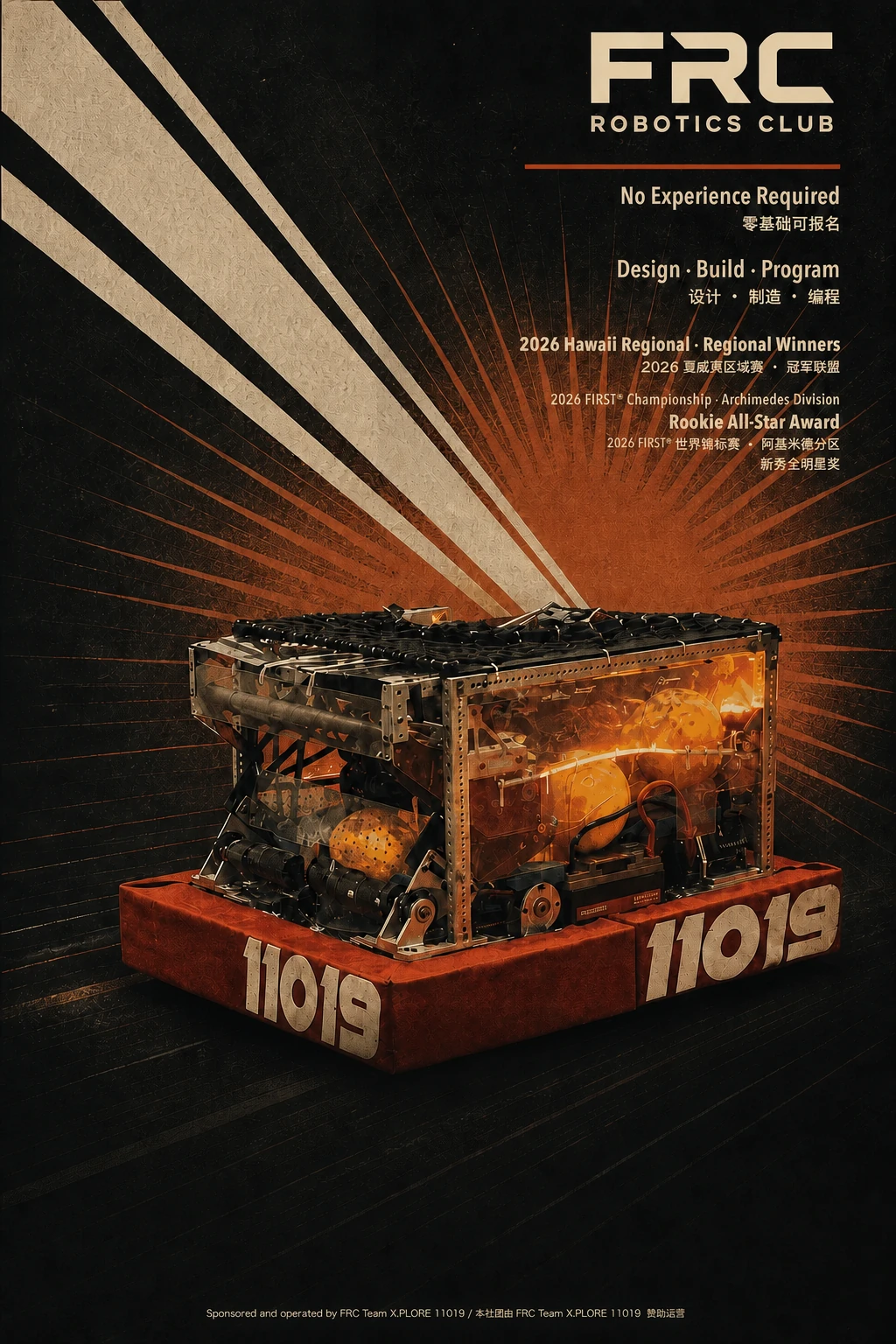
Club recruitment poster. The robot and competition achievements shown belong to FRC Team X.PLORE 11019.
- Mechanical Design
- Engineering practice as the core, supported by foundational programming
- ≥ 1/3
- Minimum share of hands-on learning
- 100%
- Transparent use of club funds
Who we are
GHFRC is a robotics club centred on mechanical design and engineering practice, with foundational programming as supporting content. We organise learning around FRC engineering scenarios so members experience the full process of understanding rules, designing structures, assembling hardware, and tuning controls.
Our core programme has two parts: each member independently completes a full CAD design for a Swerve drive chassis, and takes part in assembling and testing an FRC standard chassis. The first develops mechanical design ability; the second connects design knowledge with real components, transmissions, and control systems.
What you will learn
Rules and safety
We begin with the FIRST® programme and the fundamentals of the 2026 FRC season, including how matches work, what the robot must accomplish, and which constraints every engineering design must follow.
- Match flow and task requirements
- Robot safety and chassis-related design rules
- Safe practice during design, assembly, and testing
Mechanical design and CAD
Members use Onshape to learn CAD modelling, moving from individual parts to assemblies and gradually understanding how a complete chassis is constructed and works.
- Part modelling, assembly design, and interference checks
- Swerve drive structure and a complete chassis CAD design
- Structure, transmission, physical assembly, and mechanical inspection of an FRC standard chassis
Each wheel module in a Swerve drive can steer and drive independently. The goal is not simply to draw the shape, but to understand structure, connections, and assembly relationships well enough to complete an independent design.
Software and control
Programming serves the operation of the robot. We begin with language fundamentals and the control framework, then connect software to motors and real chassis movement.
- Java fundamentals and an introduction to WPILib
- WPILib Command-Based Programming
- Basic use of motors and motor controllers
- Manual chassis control and a simple pre-programmed autonomous routine
Turning learning into verifiable results
We want every member to leave with their own design work and genuine experience with robot hardware. The programme works towards three outcomes:
- Complete an independent design. Understand the Swerve drive structure, model parts and assemblies, and perform interference checks.
- Take part in a full assembly and testing cycle. Apply knowledge of an FRC standard chassis structure and transmission to real components, then complete a mechanical inspection.
- Make the chassis operate as intended. Assemble and tune the standard chassis so it can drive normally and complete one simple pre-programmed autonomous task.
Across independent design, hands-on assembly, and operating validation, members learn how mechanical structures and software control connect.
Our commitments to members
Hands-on work is part of the programme
Hands-on content accounts for at least one third of the programme. Every member will independently complete a Swerve drive CAD design and take part in assembling and testing a standard chassis.
Transparent funding
The use of club funds is 100% transparent. Clear financial management is a basic commitment in the way we operate the club.
Learning resources remain open to members
Course materials, CAD files, and code owned by the club are available to members for review, understanding, and continued practice.